Research

Understanding regulatory variation and trait architecture in wheat

Our research focuses on the genetic and epigenomic basis of trait variation in wheat. We integrate regulatory genomics, population genetics, deep learning, and multi-omics approaches to understand how genomic variation shapes chromatin accessibility, gene expression, and agronomic traits.

We are interested in how noncoding and regulatory variation is organized across the wheat genome and how it contributes to developmental and phenotypic diversity. By combining large-scale functional genomics with statistical and computational modelling, we aim to connect sequence variation to regulatory activity and ultimately to phenotype.

Our work spans both biological discovery and method development. In addition to studying chromatin accessibility, gene expression, and evolutionary dynamics in wheat populations, we also develop computational frameworks that help decode regulatory logic from complex omics data.

Research framework

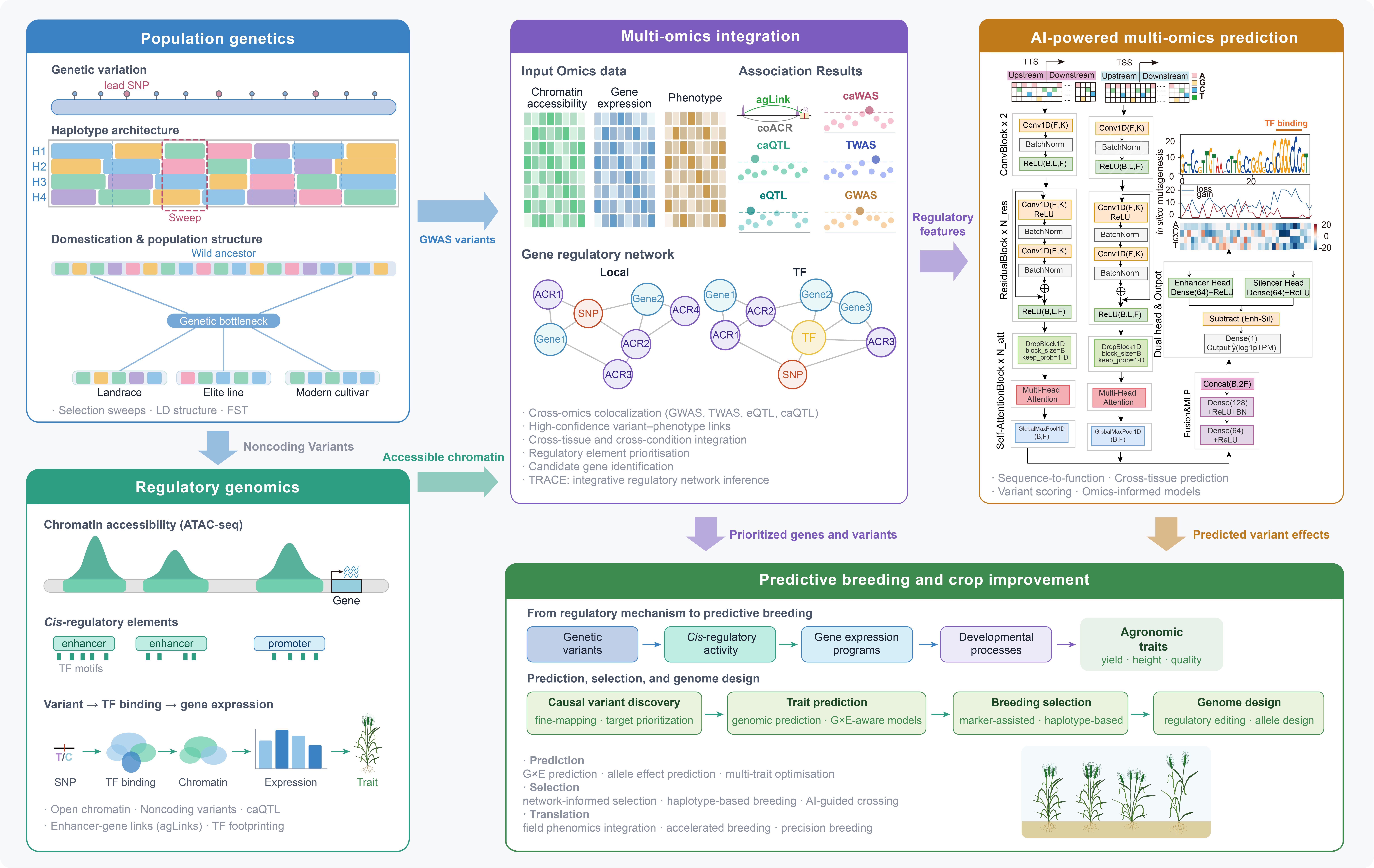
A schematic overview of our research directions and the integration of genomics, epigenomics, and computational modelling in wheat.

Overview of research themes and multi-omics integration in wheat

Overview of our research framework, integrating regulatory genomics, population genetics, deep learning, and multi-omics data to connect genomic variation with regulatory activity and phenotype.

Research Themes

Our work is organized around several complementary directions in wheat genomics, regulatory biology, and computational biology.

Regulatory genomics

We investigate how noncoding regulatory variation shapes chromatin accessibility, transcriptional activity, and complex traits in wheat. A major goal of our work is to identify cis-regulatory elements, characterize their functional variation across populations, and understand how regulatory interactions contribute to developmental and agronomic phenotypes.

Population genetics

We study population structure, haplotype architecture, domestication, and evolutionary dynamics in crop genomes. By analyzing genetic diversity across wheat populations, we seek to understand how selection, breeding, and demographic history have shaped regulatory variation and trait-associated loci.

Deep learning

We develop machine learning and deep learning approaches for regulatory element discovery and prediction of gene regulation from large-scale omics data. These models help uncover sequence determinants of regulatory activity and provide new ways to interpret genomic and epigenomic signals.

Multi-omics integration

We integrate ATAC-seq, RNA-seq, GWAS, TWAS, eQTL, and caQTL data to connect genetic variants with regulatory activity and phenotype. This systems-level strategy allows us to reconstruct multi-layered regulatory relationships and better explain how variation propagates from genome to trait.

Our approach

Our research combines experimental genomics, statistical genetics, and computational modelling to study regulatory mechanisms in wheat.

  • Population-scale profiling of chromatin accessibility, gene expression, and genomic variation.
  • Integration of association mapping and QTL-based analyses to link variants with regulatory and phenotypic effects.
  • Development of computational and AI-based methods for regulatory inference and functional interpretation.
  • Mechanistic analysis of how regulatory variation contributes to trait diversity and crop improvement.